Skip to content
RiskTemplates · The Daily Brief Thursday, October 22, 2026
Wire DOJ WHIP Whistleblower Rewards Put a 120-Day Clock on Internal Investigations OCT 20
Template Updated October 2026

Business Continuity & Disaster Recovery (BCP/DR) Kit

Set recovery priorities from a business impact analysis, catch vendors that recover slower than the processes they support, run and log tabletop exercises and tests, and report to the board on one page. Excel workbook, guide, tabletop kit, case studies and Word templates.

Price

$79

One-time. No subscription. Use forever.

Buy & download — $79 →
◆ Secure checkout ◆ Emailed access ◆ Fully editable ◆ 30-day money-back

Delivered immediately after checkout — your template and guide links are emailed to you with your receipt.

Built for risk and compliance teams at financial-services organizations

◆ Quick buying summary

What you get and when you can use it

Good fit if
Your bank partner asked for your business impact analysis, evidence of testing in the last 12 months and your open findings, and you can't produce them today
Format
Six files: an editable Excel workbook (17 tabs), three PDFs (a 38-page guide, a 36-page Tabletop Exercise Kit and 21 pages of Case Study Walkthroughs) and two editable Word templates (an 8-page Tabletop Participant Worksheet and a 11-page Crisis Communications Pack). Instant download after checkout.
Need the methodology first?
Read the Business Continuity Plan Template Guide.
Time to value
Start reviewing, editing, and assigning owners the same day; customize to your organization before sharing outputs externally.
After purchase
After payment, download every file immediately from the confirmation page. RiskTemplates also emails a secure access link, and Stripe sends the payment receipt separately. No account required.

◆ What's included

  • ◆ 17-tab Excel workbook: Start Here, Dashboard, Risk Assessment, Business Impact Analysis, Dependency Mapping, Recovery Procedures, Emergency Contacts, Test & Exercise Log, Action Items, Scenario Library, Board Report (Quarterly), four worked examples, Regulatory Reference and Lookups
  • ◆ Business Impact Analysis: four criticality tiers set by maximum tolerable downtime (Mission Critical, Essential, Important, Deferrable), an RTO <= MTD check that flags an RTO longer than the MTD in red and an RTO equal to it in amber, and an RPO check against the recovery strategy
  • ◆ Dependency Mapping: each dependency's contracted or tested recovery time compared with the process RTO, a gap flag when the dependency recovers slower, single points of failure, and the dependencies shared by two or more processes
  • ◆ Risk Assessment: threats scored 5 x 5 for likelihood and impact, a control effectiveness rating that scales inherent risk to residual, and a linked tabletop scenario for each risk
  • ◆ Recovery Procedures timed against the process RTO, Emergency Contacts with stale-contact flags, a Test & Exercise Log that calculates RTO met and RPO met from achieved results, and Action Items with owners, target dates and overdue status
  • ◆ Dashboard and one-page Board Report (Quarterly): every metric calculated from the working tabs and compared with a target; you write only the narrative
  • ◆ Sample data for Fernbrook Pay, Inc., a fictional payments fintech, plus 4 worked examples: Quillfeather Lending (consumer lender), Ashgrove Valley Community Bank, Brightkeel Platform (BaaS) and Vaultmere Digital Trust Company (digital asset custodian)
  • ◆ Regulatory Reference tab listing each source with its status, what the kit relies on it for and a primary-source link
  • ◆ 38-page guide: the US regulatory baseline, who notifies whom after an incident, the BIA method, dependencies, risk scoring, resilience strategies, testing, board reporting, five verified real disruptions and what a bank partner asks for
  • ◆ 36-page Tabletop Exercise Kit: facilitator guide, all 7 scenario cards with four timed injects each (cloud region outage, ransomware, critical vendor or core processor failure, key personnel unavailability or pandemic, social-media-driven deposit run, regional natural disaster (hurricane) and payment rail disruption), scribe and observer sheet, scoring rubric and hot wash
  • ◆ 21-page Case Study Walkthroughs: four fictional disruptions played out hour by hour, graded against RTO and MTD: ransomware at a fintech lender, a cloud region outage at a BaaS platform, a middleware bankruptcy at a consumer fintech and a social-media deposit run at a community bank
  • ◆ Editable Word templates: an 8-page Tabletop Participant Worksheet whose action items use the Action Items tab columns, and a 11-page Crisis Communications Pack with rules for holding statements, an approval chain, a message log and templates for customers, the bank partner, regulators, employees and vendors

Use rights: customize for internal business use and use outputs with your auditors, customers, bank partners, and regulators. Do not resell or redistribute the template files.

◆ Preview

See what the template covers.

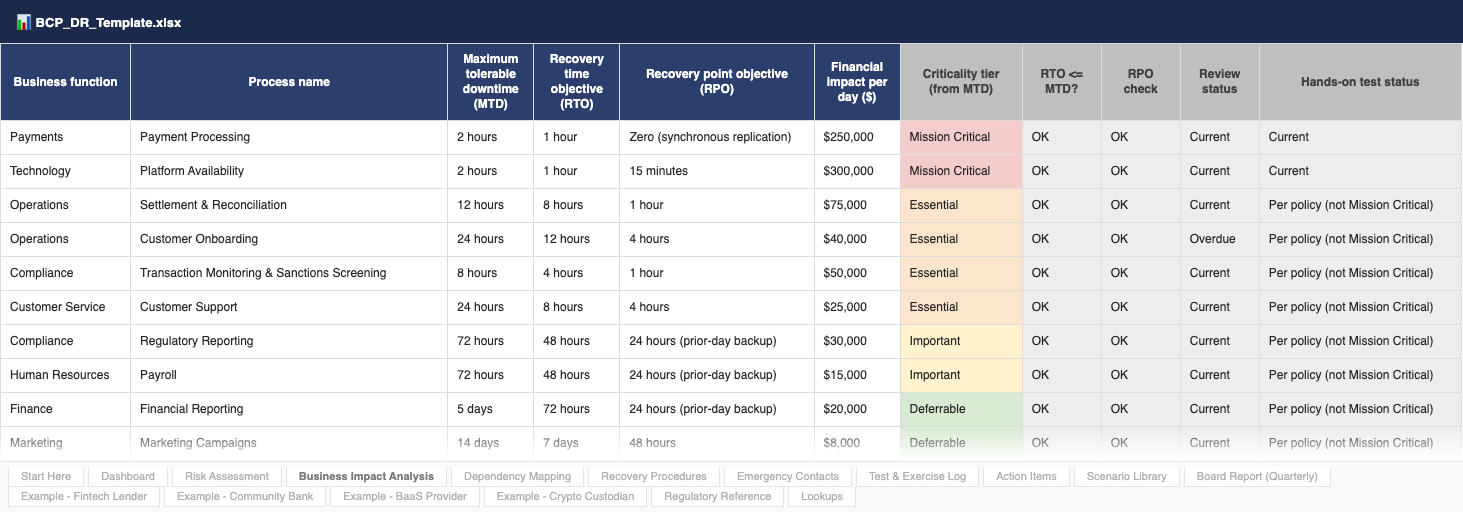
Business Impact Analysis tab with the ten Fernbrook Pay sample processes: MTD, RTO, RPO and financial impact per day, the criticality tier calculated from MTD (2 Mission Critical, 4 Essential, 2 Important, 2 Deferrable), the RTO <= MTD and RPO checks (all OK in the sample), review status and hands-on test status

Business Impact Analysis tab with the ten Fernbrook Pay sample processes: MTD, RTO, RPO and financial impact per day, the criticality tier calculated from MTD (2 Mission Critical, 4 Essential, 2 Important, 2 Deferrable), the RTO <= MTD and RPO checks (all OK in the sample), review status and hands-on test status

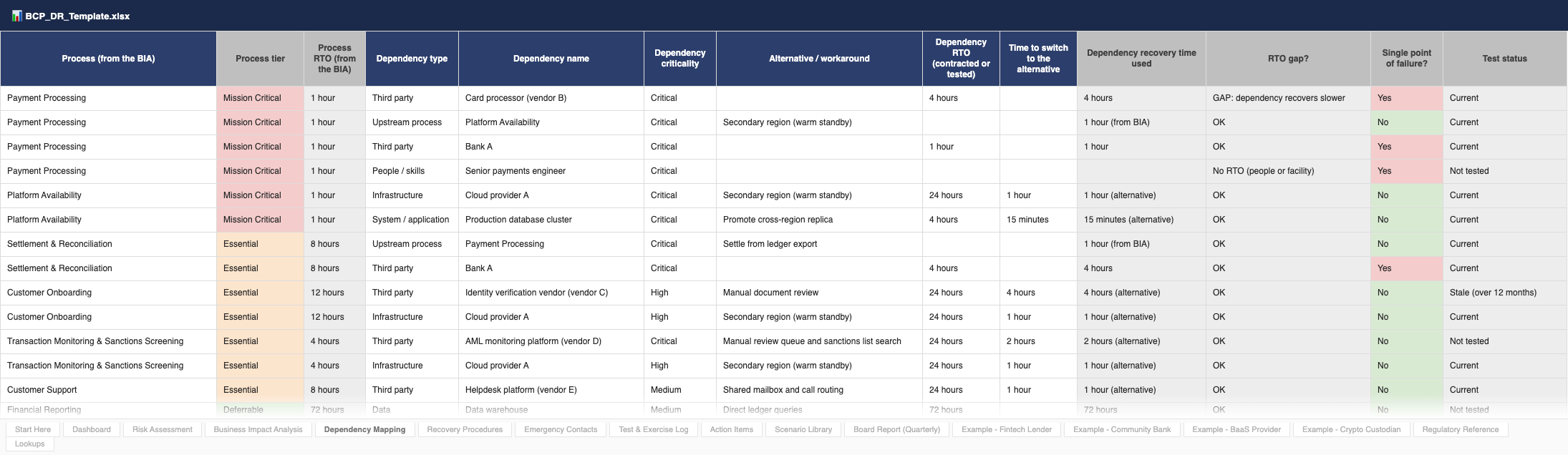
Dependency Mapping tab: each process with its dependencies, criticality, alternative, contracted or tested recovery time and the recovery time used. Card processor (vendor B) is flagged GAP: dependency recovers slower (4 hours against a 1-hour RTO), and four dependencies are flagged as single points of failure

Dependency Mapping tab: each process with its dependencies, criticality, alternative, contracted or tested recovery time and the recovery time used. Card processor (vendor B) is flagged GAP: dependency recovers slower (4 hours against a 1-hour RTO), and four dependencies are flagged as single points of failure

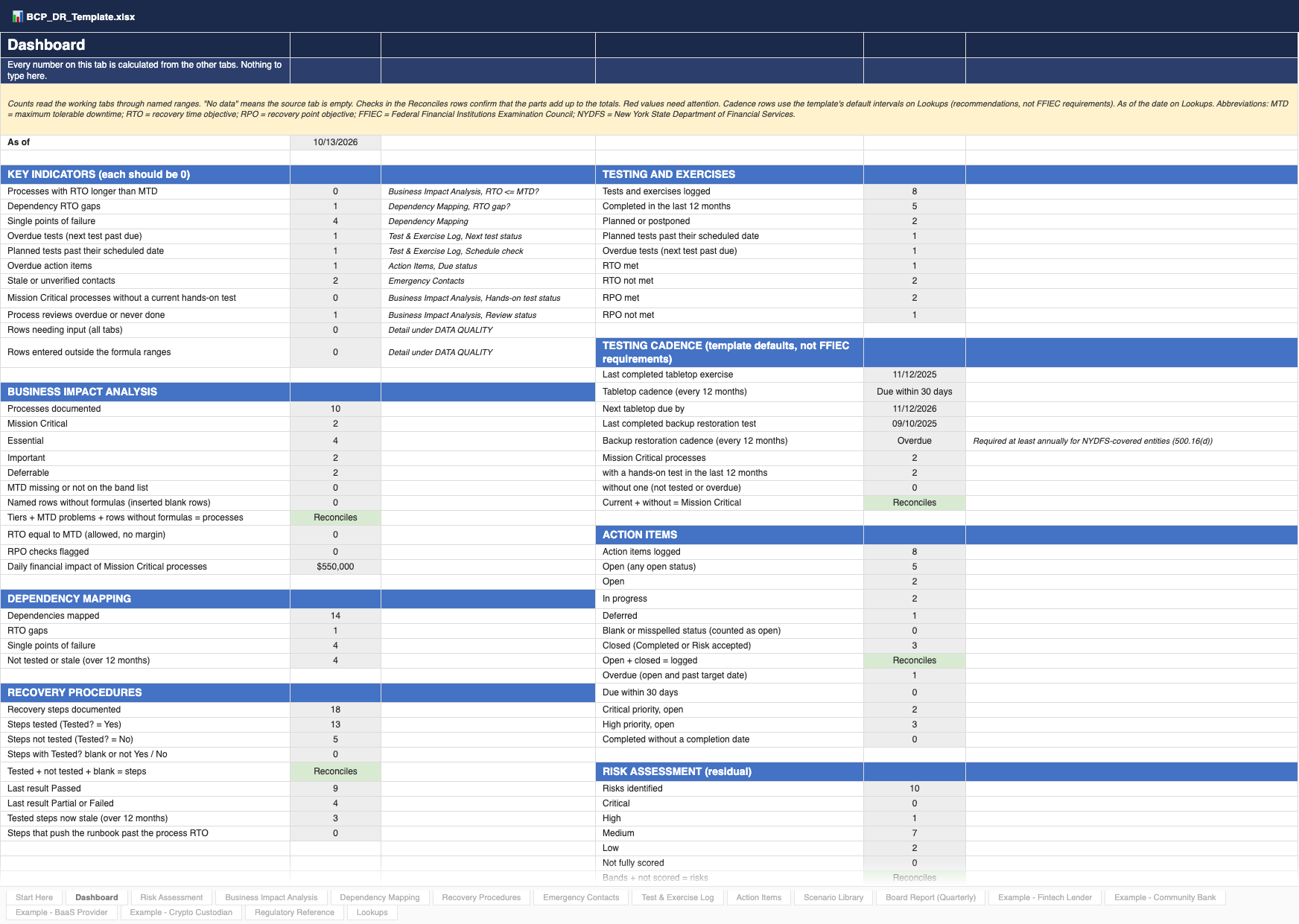
Dashboard calculated from the sample data: key indicators such as 0 processes with RTO longer than MTD, 1 dependency RTO gap, 4 single points of failure and 1 overdue action item, then counts for the BIA tiers, dependencies, recovery steps, tests, testing cadence (template defaults, not FFIEC requirements), action items and residual risk ratings

Dashboard calculated from the sample data: key indicators such as 0 processes with RTO longer than MTD, 1 dependency RTO gap, 4 single points of failure and 1 overdue action item, then counts for the BIA tiers, dependencies, recovery steps, tests, testing cadence (template defaults, not FFIEC requirements), action items and residual risk ratings

● Case file

When a dependency fails, continuity plans get tested

These public events are summarized from the sources the kit's guide cites. They are context for scenarios and discussion, not proof that a particular plan or template would have prevented the disruption or losses.

July 2024

Endpoint-security update outage

A faulty CrowdStrike sensor update crashed Windows machines around the world. Microsoft estimated that it affected 8.5 million Windows devices, less than one percent of all Windows machines, and the cloud insurer Parametrix estimated the direct loss to Fortune 500 companies, excluding Microsoft, at $5.4 billion.

Why it mattersWhen the same agent runs on every machine, redundancy inside your own estate doesn't help. The kit maps it to a faulty-vendor-update risk and to dependency concentration.

2024

Banking-as-a-service middleware failure

After the BaaS middleware provider Synapse failed in 2024, its partner banks, with the help of the Chapter 11 trustee, found that the funds they held for end users were less than Synapse's records showed. The trustee estimated the shortfall at $60 million to $90 million, according to the Consumer Financial Protection Bureau's complaint (paragraph 50).

Why it mattersThe ledger of record can sit with a middleware provider. Don't tell customers their funds are safe until reconciliation confirms it; TTX-03 and Case Study 3 exercise exactly this.

2023

MOVEit file-transfer breach

A single file-transfer product became a shared dependency for thousands of firms at once: by Emsisoft's count as of June 28, 2024, the campaign reached 2,773 organizations.

Why it mattersA tool used by many of your vendors is a hidden fourth-party concentration. Ask vendors what they depend on and record it on Dependency Mapping.

Each of these was a dependency failing: a security agent, a middleware ledger, a file-transfer product, a health care technology platform. If you're checking whether your program would hold up, here's what you'd recognize:

◆ Good fit if any of these sound familiar

When teams reach for this template.

Your bank partner asked for your BIA, test results and open findings.

The workbook produces each one: the Business Impact Analysis filtered to the processes in your program, the Test & Exercise Log with RTO met and RPO met calculated from achieved results, and Action Items filtered to open items. The guide lists what bank partners commonly ask for and which tab answers it.

Your continuity plan says "notify the OCC within 36 hours" and you're a fintech.

The 36-hour clock belongs to the bank (12 CFR 53.3). A fintech that provides covered services to a bank notifies the bank under 12 CFR 53.4. The guide, the scenario cards and the Crisis Communications Pack assign every notice to the right sender.

Your policy cites "FFIEC requires annual tabletops."

The FFIEC Business Continuity Management booklet sets no fixed frequency; section VII.B leaves it to your policy. The guide sorts out which requirements are real (such as NYDFS 500.16(d) annual testing for covered entities) and which citations to stop using, and the workbook marks its cadences as template recommendations.

◆ Why now

Rebuilt in October 2026 (version 2026.10.1)

Every piece of the kit now shares one set of numbers: four tiers set by maximum tolerable downtime, a 5 x 5 risk scale and seven tabletop scenarios, including new hurricane (TTX-06) and payment rail (TTX-07) scenarios. The Tabletop Participant Worksheet and Crisis Communications Pack are new Word templates, section references follow the FFIEC booklet's own numbering, and the regulatory sources were checked against primary text on October 13, 2026. The September 2026 interagency third-party proposal is listed as proposed only.

◆ Where this fits

Where this fits in your risk program

  • ◆ Start here if you need a business impact analysis, recovery targets you can defend and a record of exercises, tests and findings.
  • ◆ Pair it with the Incident Response & Breach Notification Kit for the incident itself: severity, breach notification and the notices an incident starts.
  • ◆ Pair it with the TPRM Kit to tier the vendors that Dependency Mapping shows your critical processes rely on.
  • ◆ Pair it with a Contingency Funding Plan kit if a deposit run (TTX-05) or a sponsor bank problem would hit your liquidity.

◆ What this isn't

Setting expectations.

  • × Not legal advice, and it does not guarantee examiner or bank-partner acceptance: tailor it to your program and confirm which rules apply with counsel.
  • × Not software or a business continuity platform: an Excel workbook, three PDFs and two Word templates.
  • × Not international: US guidance and rules only.
  • × Not a substitute for hands-on testing: tabletop exercises test decisions; failover and backup restoration tests prove recovery times.

◆ 30-day rollout plan

A sample first 90 days

If you are starting from nothing, the guide suggests this sequence. Adjust it for your scope and the people available.

  1. Weeks 1-2

    List processes and score threats

    List every process with its owner on the Business Impact Analysis tab and score the top ten threats on Risk Assessment.

  2. Weeks 3-6

    Run BIA workshops and map dependencies

    Run one workshop per function to set MTD, RTO and RPO and fix every red flag, then map dependencies for the Mission Critical and Essential processes and ask each critical vendor for its recovery time in writing.

  3. Weeks 7-10

    Write runbooks and run the first tabletop

    Write runbooks for the Mission Critical processes, verify every emergency contact, then run your first tabletop on the scenario linked to your highest residual risk and log the findings.

  4. Weeks 11-12

    Policy, board report and test calendar

    Draft the policy, print the first Board Report and schedule the first hands-on test.

◆ Full playbook in the PDF guide

The guide covers each step in detail; the Tabletop Exercise Kit has the agenda, roles and logistics checklist for the exercise.

◆ Regulatory alignment

Designed around the FFIEC booklet and the US rules that apply

Sources were checked against primary text as of October 13, 2026, and each is listed on the Regulatory Reference tab with its status:

  • ◆ FFIEC IT Examination Handbook, Business Continuity Management booklet (November 2019): II Governance, III.A Business Impact Analysis, III.B Risk Assessment, IV.A Resilience, IV.B Communications, V Business Continuity Plan, VI Training, VII Exercises and Tests, VIII Maintenance and Improvement, IX Board Reporting and Appendix A. It sets no fixed testing frequency (VII.B leaves that to your policy); the kit's cadences are recommendations
  • ◆ NYDFS cybersecurity regulation, 23 NYCRR 500.16 (amended November 1, 2023): separate incident response and business continuity and disaster recovery plans, tested at least annually with backup restoration, for covered entities
  • ◆ Computer-Security Incident Notification rule: 12 CFR 53.3 (a bank notifies its primary federal regulator within 36 hours) and 12 CFR 53.4 (a bank service provider, including a fintech, notifies its bank), with Federal Reserve and FDIC parallels
  • ◆ Interagency Guidance on Third-Party Relationships: Risk Management, 88 FR 37920 (2023), in effect; the September 2026 proposal to replace it is listed as proposed only
  • ◆ Interagency Sound Practices to Strengthen Operational Resilience (Federal Reserve SR 20-24), written for the largest firms and used here for US terms such as critical operations and tolerance for disruption
  • ◆ Addendum to the Interagency Policy Statement on Funding and Liquidity Risk Management (July 28, 2023) and the FTC Safeguards Rule, 16 CFR 314.4(h)
  • ◆ References, not certifications: NIST SP 800-34 Rev. 1 for MTD, RTO and RPO, and ISO 22301:2019 with Amendment 1:2024 for climate change considerations in the hurricane scenario

Regulatory Reference also lists citations to stop using: Federal Reserve SR 14-1 does not apply to continuity or contingency funding planning (it covers recovery and resolution preparedness for certain large bank holding companies), and the FFIEC Cybersecurity Assessment Tool was sunset on August 31, 2025.

Last updated: October 13, 2026

◆ Template guide

Business Continuity Plan Template Guide

How to build a business continuity plan template for US fintechs, BaaS programs and small banks: business impact analysis, recovery objectives, dependency gaps, tabletop exercises, tests and board reporting.

Read guide →

◆ FAQ

Frequently asked questions.

How are processes tiered?

By maximum tolerable downtime (MTD), the longest a process can be down before the harm is unacceptable. Mission Critical is an MTD under 4 hours; Essential is 4 hours up to and including 24 hours; Important is over 24 hours up to 72 hours; Deferrable is more than 3 days. The tier comes from the MTD alone, so an ambitious recovery time objective (RTO) can't promote a process that can in fact wait. The workbook then checks that each RTO is shorter than or equal to the MTD, flagging an RTO longer than the MTD in red and one equal to it in amber, and shows "CHECK MTD" for a typo instead of quietly treating it as Deferrable.

What does the dependency gap flag catch?

A vendor, system or upstream process that recovers slower than the process that relies on it. Enter the dependency's contracted or tested recovery time (or the time to switch to an alternative) and the workbook compares it with the process RTO. The FFIEC booklet makes the same point in section III.A.3: a process with a shorter RTO that depends on one with a longer RTO may indicate a gap. In the sample, the card processor's contracted 4-hour recovery time is flagged against Payment Processing's 1-hour RTO. Critical or High dependencies with no alternative are counted as single points of failure.

Which tabletop scenarios are included?

Seven, each with a scenario card, four timed injects, discussion questions, what good looks like and the notices it can trigger: TTX-01 cloud region outage, TTX-02 ransomware, TTX-03 critical vendor or core processor failure, TTX-04 key personnel unavailability or pandemic, TTX-05 social-media-driven deposit run, TTX-06 regional natural disaster (hurricane) and TTX-07 payment rail disruption (Fedwire, FedACH or a card network). The kit is planned around a two-hour session, and the Scenario Library tab tracks when each scenario was last run. Four of the scenarios have a matching case study; TTX-04, TTX-06 and TTX-07 do not.

Does it meet FFIEC or NYDFS testing requirements?

It is designed around them, but no template can meet them for you. The FFIEC Business Continuity Management booklet sets no fixed testing frequency: section VII.B says your own exercise and test policy should establish minimum frequency, scope and reporting. The kit's cadences (for example a tabletop and a hands-on test of each Mission Critical process every 12 months) are template recommendations you can change. If you are covered by the New York State Department of Financial Services (NYDFS) cybersecurity regulation, 23 NYCRR 500.16(d) requires testing your incident response and business continuity and disaster recovery plans, and your ability to restore from backups, at least annually. The booklet also says tabletop exercises by themselves are likely insufficient to validate recovery capabilities, so the workbook tracks hands-on tests separately.

We're a fintech. Who do we notify after an outage?

Usually your bank, not the bank's regulator. Under 12 CFR 53.4 and the Federal Reserve and FDIC parallels, a bank service provider notifies at least one bank-designated contact at each affected bank as soon as possible after determining that a computer-security incident has materially disrupted or degraded, or is reasonably likely to, covered services for 4 or more hours. The bank then decides on its own 36-hour notice to its primary federal regulator under 12 CFR 53.3. Your program agreement may require more, sooner. The guide, the scenario cards and the Crisis Communications Pack all assign each notice to the right sender.

What's in the Crisis Communications Pack?

An editable Word document with rules for holding statements (what to say before facts are confirmed, and the claims that need sign-off first), an approval chain and message log, and templates for customers, the bank partner, regulators (drafted for the right sender), employees and critical vendors, plus a map of which templates each scenario uses. Every placeholder is a yellow [BRACKETED] field to replace.

Is the workbook editable, and which version of Excel do I need?

Yes. Nothing is locked or protected: white cells are inputs and gray cells are formulas. It has pre-built rows for 60 risks, 60 processes, 150 dependencies, 200 recovery steps, 60 contacts, 100 tests and 150 action items. It uses standard functions such as INDEX, MATCH, COUNTIFS, SUMPRODUCT and EDATE, with no XLOOKUP or dynamic-array functions, so Excel 2016 or later works. Enter dates as mm/dd/yyyy.

Is it aligned with ISO 22301 or NIST SP 800-34?

It draws on both but is not built to either. The MTD, RTO and RPO definitions and the rule that the RTO should be shorter than the MTD come from NIST Special Publication 800-34 Rev. 1, and the hurricane scenario cites ISO 22301:2019 Amendment 1:2024 for climate change considerations. The kit is not an ISO 22301 management system and does not prepare you for certification.

Can I share completed outputs externally?

Yes. You can use completed outputs with auditors, customers, bank partners, regulators, and internal stakeholders. Customize the template for internal business use — just don't resell or redistribute the source template files.

How do I receive the files?

Checkout is handled through Stripe. After payment, download every file immediately from the confirmation page. RiskTemplates also emails a secure access link, and Stripe sends the payment receipt separately. No account is required.

What if it's not a fit?

Email within 30 days for a full refund, no questions asked. The guarantee is meant to remove purchase risk while you evaluate whether the template fits your use case.
● First-time buyer offer

Get 20% off your first template.

Drop your email and we'll send the code.

◆ Not ready to buy?

Start with the free Risk Register.

141 pre-populated fintech risks across 21 categories. ISO 31000 structure.

Download free Risk Register →

◆ Related templates

Pairs well with.

Template
$69

Incident Response & Breach Notification Kit

Run an incident and every notice clock it starts: bank partner, the bank regulators' 36-hour rule, NYDFS, FTC, SEC and breach laws in 54 states and territories. Workbook, guide, four playbooks, tabletop kit and Word plan templates.

Template
$69

Third-Party Risk Management (TPRM) Kit

Tier every vendor with one documented rule, run due diligence and AI vendor reviews, find contract gaps against the 2023 Interagency Guidance, and track SOC reports, issues, concentration and exits. Excel workbook, guide, Word policy and offboarding checklist.

Template
$79

Contingency Funding Plan — Fintechs

Contingency funding plan for sponsor-bank fintechs — FBO reconciliation, runway-based triggers, post-Synapse stress scenarios.

◆ Ready when you are

Get the Business Continuity & Disaster Recovery (BCP/DR) Kit.

Start building a defensible risk program today.

Buy & download — $79 →
◆ Secure checkout ◆ Emailed access ◆ Fully editable ◆ 30-day money-back

Immaterial Findings · Newsletter

The brief, in your inbox.

Enforcement of the week, a framework breakdown, and the prompts that are actually worth running. Delivered to your inbox. Free.